| Jimi Blake “If You Go Down to the Woods Today” Woodland and Shade Loving Plants, Huntingbrook.com |
 |
Jimi Blake gardens at Hunting Brook in County Wicklow, near Dublin, Ireland. He is constantly experimenting, trying out new plants and plant combinations, propagating many of his perennials from cuttings and seed and growing them in exuberant mixed borders and shady areas for his choice woodland plants. Jimi has been removing spruce trees from the edge of his garden to allow more woodland and the focus of his talk to us will be growing woodland and shade loving plants and growing them well. |
 |
| “If You Go Down To the Woods Today” Woodland Plants in Hunting Brook Gardens, Ireland Notes on Jimi Blake’s March 26, 2012 lecture |
|
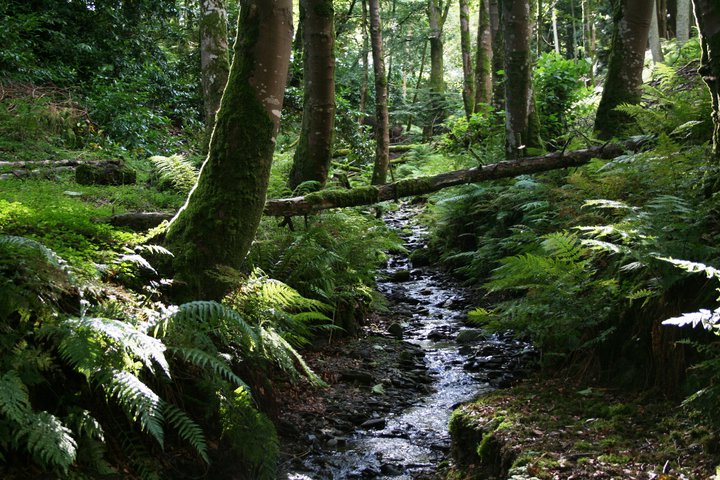
Nestled in the foothills of the Wicklow Mountains, about 15 kilometers from Dublin, lies Hunting Brook Gardens, one of the most exciting, innovative gardens in Ireland, or anywhere. Its creator is Jimi Blake, an enthusiastic, young plantsman, who inherited 20 acres of the family estate in 2002. This site is on a steep slope of land about 900 feet above sea level, where the climate is moderate and the soil acidic. Given the imagination and skill of Jimi Blake, its sheltered aspect has allowed for a mix of hardy, half-hardy and exotic, while the steep banks have provided an opportunity to create highly dramatic effects, and to bring plants normally growing at knee height up to eye level. The plant collection was almost immediately enriched when Jimi went with the Dublin National Botanic Gardens on a plant-hunting expedition to China in 2003, returning with some 450 varieties of plant material, including Aralia echinocaulis, now one of his signature plants. Although Jimi wants to grow every plant on the planet, he has also been careful to preserve the natural beauty of his 15 acres of woodland – the main focus of his presentation to us on March 26. The woodland is a glaciated valley of native beech, oak, ash and sycamores with stands of spruce and larch planted in the early part of the 20th-century. This natural setting is filled with the romance of historical associations. The garden gets its name from a small stream at the bottom of the woodland valley, identified on an 1837 Ordnance Survey map as “Hunting Brook”. The remains of a ring-fort said to be 7th-century, together with an ancient standing stone, are further links to ancient Irish history and culture. We were given many useful tips on propagation and cultivation of woodland plants: we were advised to buy erythroniums in the green and not to over feed them; sow primulas in the green when they finish flowering and surface-sow. If the potting mix dries out, sprinkle on some grit; cardiocrinums can be divided when they come into leaf; meconopsis need more light than books would lead us to believe - they do well in “full Irish sun” as do hellebores; the best dividing time for galanthus is in June. Above all, crumbly leaf-mould and well-rotted manure is the best mulch for a woodland garden. As we were treated to some wonderful photos of plants combined with Jimi’s enthusiastic commentary, I can imagine that many plant wish lists underwent a significant increase! First of all there was Jimi’s signature plant, Aralia echinocaulis, forming a unique, spiny backbone to a steep bank of planting. They cast very little shade and they have proved to be very hardy, surviving the -15C that killed a companion planting of Dicksonia antarctica. It was conceded that the main excitement in mid-winter might be searching the Internet for new plants with a glass of wine in hand, but Jimi also showed us several reliable plants to chase away the blues: Ypsilandra thibetica reliably produces its fragrant blooms in February; Viburnum betulifolium holds on to its brilliant red-currant-like berries all winter, and looks stunning with rain drops or with snow; Primula florindae ‘Keilour Hybrids’, with its immense heads of fragrant flowers in spring, has fabulous winter seed heads. Immense leaves and unusual, contrasting shapes are a special passion of Jimi’s and perhaps the most exciting foliage plant of them all was the highly architectural Schefflera macrophylla, discovered in the Fan Xi Pan area of Northern Vietnam by Sue and Bleddyn Wynn-Jones from Crûg Farm Nursery. This fabulous plant can reach seven-meters, with one-meter-wide leaves on purple stems and ginger indumentum on the new growth. Jimi has planted it in his new garden in the former car park, called “Ashley’s Garden”, a memorial to his friend Ashley Catin. Although Hunting Brook is an amazing tour-de-force, it is nevertheless a highly personal garden, and although rare botanical treasures abound, there is an abiding devotion to the preservation of the natural beauty of this incredible site. | |